
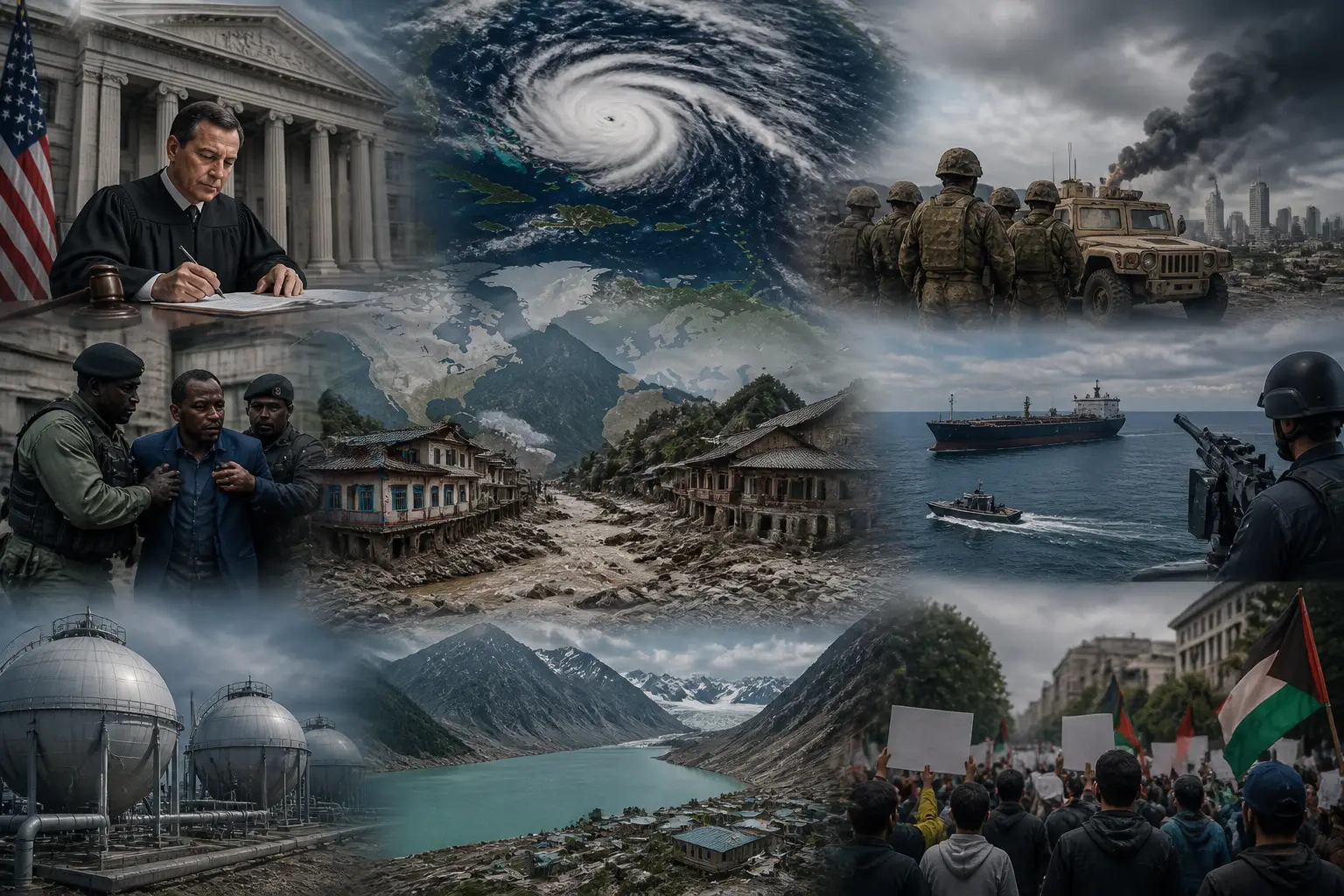
Legal challenges to US government actions, climate-related disasters, and regional conflicts shape the global news landscape today, with recent developments including a federal judge ruling against sanctions on an AI firm, tropical storm remnants affecting the Caribbean, and a catastrophic flood in Nepal and Tibet linked to glacial collapse.
The 60-second global view
Legal and political tensions in the US, climate-related disasters in Asia Pacific and Africa, and regional conflicts in the Middle East and Europe are the dominant themes in today's news. A US judge ruled that the Trump administration's blacklisting of Anthropic was unlawful, highlighting tensions between AI firms and government agencies. In Asia Pacific, floods in Nepal and Tibet underscore the growing risks of climate change in vulnerable regions. Meanwhile, in the Middle East, conflict between Iran and US-Israeli forces has led to the closure of the Strait of Hormuz, impacting global oil trade. In Europe, gas reserves are at their lowest in 13 years, raising concerns about energy security as winter approaches.
Across the regions
Africa
Zambian opposition leader Brian Mundubile has been detained on treason charges following disputes over the recent presidential election results. Incumbent President Hakainde Hichilema secured 60% of the vote, compared to Mundubile's 38%. Security forces raided a property in Lusaka linked to Mundubile shortly after the vote, killing a former cabinet minister and arresting several politicians. The authorities accused the opposition of planning an armed insurgency, which they denied.
Americas
Tropical Storm Dolly has been downgraded to an open tropical wave and is expected to bring heavy rainfall to parts of the Caribbean this weekend. The remnants of the storm, which formed on Thursday with maximum sustained winds of near 40mph, are moving across the Atlantic Ocean toward the Leeward Islands. Forecasters said that Dolly is no longer a tropical storm and has become an open tropical wave, with heavy rains expected to affect the Leeward Islands, Virgin Islands, Puerto Rico, and Hispaniola.
Asia Pacific
A catastrophic flash flood in Nepal and Tibet, triggered by a glacial collapse, has killed hundreds and exposed the growing risks of climate change in mountainous regions. The flood, which occurred on 26 August, involved a surge of ice, water, rock, and mud that destroyed infrastructure and communities along the Lhende Khola, Bhotekoshi, and Trishuli rivers. Authorities warn that rising water levels in two lakes near the Nepal-China border could lead to additional flooding, as the death toll climbs to at least 584 and missing persons in Nepal nearly double to 1,924.
- Nepal-Tibet flood highlights climate crisis impact on vulnerable regions
- Nepal-Tibet floods: Rising lake levels raise fears of further disaster
Europe
European gas reserves are at their lowest level in 13 years as the continent prepares for winter, raising concerns about potential price volatility and energy security. The EU’s gas storage levels stood at 63% in late August, significantly below the 80% average for this time of year and the lowest recorded since 2013. This has prompted warnings from analysts about increased price volatility during the colder months, with the UK being particularly vulnerable due to its reliance on imports and limited domestic storage capacity.
Middle East
US and Israeli strikes on Iran began in February 2026, leading to regional conflict and closure of the Strait of Hormuz, a key oil shipping route. On 28 February 2026, the US and Israel launched large-scale strikes on Iran, prompting Tehran to retaliate against Israeli and US allies across the Gulf. The conflict rapidly expanded into a regional war with global economic consequences. The situation has since seen repeated cycles of fighting, ceasefires, and failed negotiations, with the Strait of Hormuz remaining central to the crisis.
US
A US judge ruled that the Trump administration's designation of AI startup Anthropic as a supply chain risk was unlawful, calling the move 'illegal and baseless'. The ruling followed Anthropic's refusal to allow the military to use its AI models for tasks such as surveillance or autonomous weapons. In a separate case, an autopsy report shows that a bullet fired by Tennessee National Guard members struck 20-year-old Tyrin Johnson in the back, contradicting the initial account that he was shot in the chest. The findings have sparked calls for accountability from Johnson's family.
- US judge rules Pentagon's blacklisting of Anthropic was unlawful
- Autopsy reveals National Guard fatally shot Memphis man in the back
- Judge rules Trump administration's actions against Anthropic were unlawful
What connects them
Legal challenges in the US against government actions against AI firms are linked to broader concerns about national security and free speech. In Asia Pacific, the flood in Nepal and Tibet highlights the growing risks of climate change in vulnerable regions, while rising lake levels near the Nepal-China border raise fears of further disaster. In the Middle East, the conflict between Iran and US-Israeli forces has led to the closure of the Strait of Hormuz, impacting global oil trade. In Europe, the low gas reserves raise concerns about energy security as winter approaches, with the UK being particularly vulnerable. These developments are interconnected through their global economic and environmental implications, with each region facing unique but significant challenges.
This section reflects Dumpling editorial interpretation and is provided for context only.
What to watch
- Legal challenges to US government actions against AI firms may set a precedent for future disputes.
- Rising water levels in Nepal and Tibet could lead to further flooding and displacement.
- Low gas reserves in Europe may lead to increased price volatility and energy insecurity as winter approaches.
This section reflects Dumpling editorial interpretation and is provided for context only.