
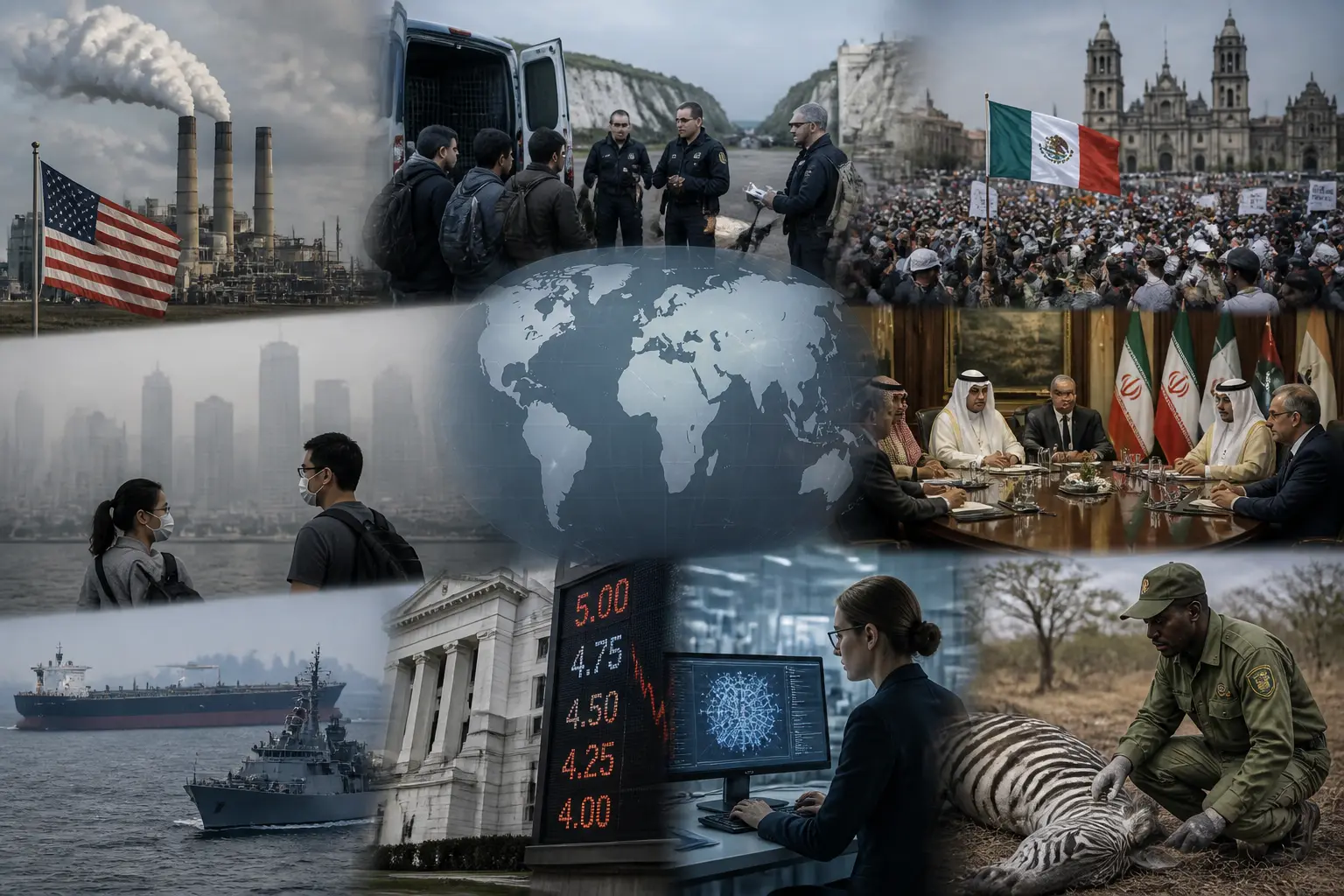
Today's global news includes a potential US reversal on power-plant pollution limits, European asylum seeker injuries, and Middle East tensions affecting oil prices and regional diplomacy.
The 60-second global view
Global events today reflect a mix of regulatory shifts, humanitarian concerns, and geopolitical tensions. In the US, environmental policy changes could reshape climate regulation, while in Europe, asylum seekers returned from the UK report injuries linked to detention. In the Middle East, rising tensions have driven oil prices and delayed diplomatic talks. Meanwhile, Singapore faces its worst air quality in seven years due to Indonesian fires, and Zambians are warned against consuming dead wildlife after an anthrax outbreak. These developments highlight the interconnected nature of global challenges and the need for coordinated responses.
Across the regions
Africa
Zambians are being warned against consuming meat from dead wildlife after an anthrax outbreak that has killed dozens of animals. At least 12 people are being treated for anthrax, and authorities have suspended hunting in the affected area. The outbreak has been reported in the Munyamadzi Game Management Area, where wildlife carcasses have been found and consumed by local communities.
Americas
Thousands of residents in Culiacán, Mexico, protested over cartel violence linked to a feud between rival factions of the Sinaloa cartel. The demonstration, held on the second anniversary of the conflict, was organized by relatives of missing persons, local businesses, and civil society groups. The violence has led to a significant increase in murders, disappearances, and economic disruption, with over 5,000 businesses closing since the conflict began.
Asia Pacific
Singapore's air quality has entered the unhealthy range for the first time in seven years due to haze from Indonesian fires. Four of five regions in Singapore recorded unhealthy levels, with the central region's Pollutant Standards Index reaching 154. The National Environment Agency attributes the worsening conditions to shifting winds carrying smoke plumes from fires in Kalimantan and southern Sumatra.
- Singapore air quality enters unhealthy range as haze persists from Indonesia
- Haze pushes air quality across Singapore into unhealthy range for first time in 7 years
Europe
French health services have documented injuries among asylum seekers returned to France under the UK’s ‘one in one out’ deportation scheme. Meanwhile, a study suggests that US efforts to lower drug prices could delay European patient access to new medicines. In addition, the European Central Bank president warned that Europe must develop its own AI technology to avoid dependency on the US and China.
- Asylum seekers returned to France report injuries after UK detention
- US drug pricing push may delay European patient access to new medicines
- ECB chief warns Europe must develop AI to avoid dependency on US or China
Middle East
Gulf states have postponed a key meeting with Iran on the future of the Strait of Hormuz due to rising tensions and Houthi advances in Yemen. At the same time, US borrowing costs have reached 5% for the first time since 2023, driven by rising oil prices linked to Houthi attacks on Saudi infrastructure and the ongoing Middle East conflict.
- Gulf states delay Hormuz talks with Iran as Yemen conflict escalates
- US borrowing costs reach 5% as oil prices rise due to Middle East tensions
US
The US Environmental Protection Agency is expected to repeal carbon pollution limits for coal- and gas-fired power plants. This move, which follows a series of regulatory actions aimed at revising environmental protections, is likely to face legal challenges from environmental groups and could prevent future administrations from regulating greenhouse gas emissions from power plants.
What connects them
The US environmental policy shift and the European concerns over asylum seeker injuries both reflect broader regulatory and humanitarian challenges. In the Middle East, rising tensions have driven oil prices and delayed diplomatic talks, while in Asia Pacific, Singapore's air quality crisis is linked to Indonesian fires. These developments are interconnected, with environmental, economic, and geopolitical factors influencing each region. The US policy change may have global implications, affecting not only domestic environmental regulation but also international efforts to combat climate change. Similarly, the European Central Bank's warning about AI dependency highlights the need for global technological self-sufficiency, which could influence trade and economic negotiations.
This section reflects Dumpling editorial interpretation and is provided for context only.
What to watch
- US environmental policy changes may face legal challenges and impact future climate regulation.
- European asylum seeker injuries could lead to increased scrutiny of UK deportation schemes.
- Rising oil prices due to Middle East tensions may affect global economic stability.
This section reflects Dumpling editorial interpretation and is provided for context only.