
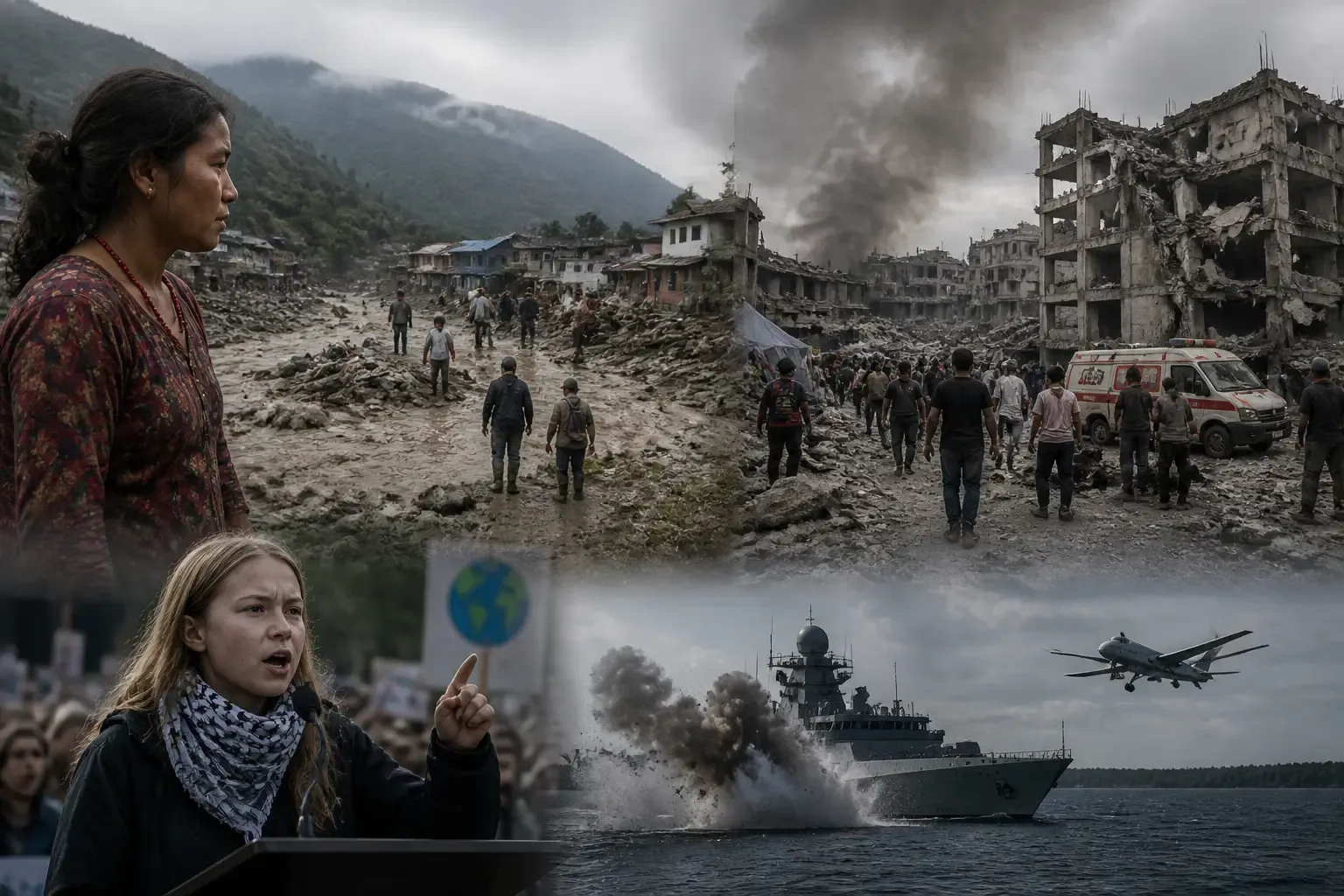
Global headlines today focus on climate-related disasters, rising tensions in the Middle East, and expanding financial access in Asia. Nepal grapples with the aftermath of a glacier collapse, while Gaza faces renewed humanitarian concerns following an Israeli strike on a hospital.
The 60-second global view
Climate change and geopolitical tensions are shaping the global news landscape. In Nepal, a glacier collapse triggered floods that devastated communities, highlighting the growing risks of climate-related disasters. In the Middle East, an Israeli strike on a Gaza hospital has reignited concerns about civilian casualties and stalled humanitarian aid. Meanwhile, in Europe, Greta Thunberg's sharp critique of global inaction on climate change has drawn attention at the Cop31 summit. In Asia, financial reforms are enabling Indian investors to access US markets, while a potential data breach in Singapore raises concerns about cybersecurity. These developments underscore the complex interplay between environmental, economic, and political challenges on a global scale.
The interconnected nature of these events reveals a world grappling with both immediate crises and long-term systemic issues. Climate change is increasingly linked to natural disasters, while geopolitical conflicts continue to disrupt humanitarian efforts. At the same time, financial and technological advancements are reshaping economies, even as cybersecurity threats grow. These stories reflect the urgency of addressing both environmental and social challenges in an increasingly interconnected world.
Across the regions
Americas
Panama City is facing a deepening waste crisis that disproportionately affects poor neighborhoods on the outskirts of the city. In San Miguelito, residents live amid rotting waste, flies, and the constant threat of disease. Yamileth, a local resident, describes the stench and odors that plague her family daily, expressing concern for her children's health and a sense of abandonment. The government has pledged funding to address the issue, but much of the effort has fallen to environmental organizations. The waste crisis is at odds with Panama's ambitions to become a tourist destination and high-income city, highlighting the challenges of urban development and environmental management in the region.
Asia Pacific
In Nepal, a 17-year-old Red Cross volunteer recounts the devastation caused by floods triggered by a glacier collapse, an event made more likely by climate change. The disaster destroyed homes, disrupted infrastructure, and left many without electricity. In Singapore, the Agency for Integrated Care (AIC) reported a potential data breach affecting 4,064 healthcare and community care employees, with personal information such as names, contact numbers, and NRIC numbers potentially accessed. Meanwhile, in India, major stockbroking apps have expanded services to allow retail investors to buy US stocks, reflecting a shift in investment habits and growing interest in global markets. These developments highlight the diverse challenges and opportunities facing the Asia Pacific region, from climate-related disasters to technological and financial advancements.
- Nepal flood survivor describes glacier collapse and its impact on her community
- AIC reports potential data breach affecting 4,064 healthcare and community care employees
- Indian trading apps expand to let retail investors buy US stocks
Europe
At the Cop31 climate summit in Antalya, Turkey, Greta Thunberg accused world governments of failing to prevent environmental breakdown, stating the planet is 'being killed' rather than 'dying.' Her remarks emphasized the urgent need for action on climate change and its links to global crises. In the Baltic Sea, Ukrainian drones attacked a Russian warship in the Gulf of Finland, marking the first known strike on a Russian ship in open Baltic Sea waters. The attack, part of a broader drone operation against Russia's Ust-Luga oil export depot, highlights the ongoing tensions in the region and the potential for expanded Ukrainian operations into the Baltic region.
- Greta Thunberg accuses world governments of failing to prevent environmental breakdown at Cop31 climate summit
- Ukrainian drone strikes Russian warship in Gulf of Finland
Middle East
An Israeli strike on a Gaza hospital killed six and injured 28, raising concerns over civilian deaths and stalled humanitarian aid. The Israeli military claimed the strike targeted a Hamas commander, but did not provide evidence to support the claim. International concerns have been growing over the deliberate targeting of medical facilities and healthcare workers. Meanwhile, Israeli opposition figures have continued to express rhetoric targeting Palestinian children, even after the ruling party lost its majority in recent elections. These remarks include claims that every child in Gaza is an enemy and that newborns are already terrorists from birth. The statements have been made by figures across the political spectrum, including centrist and opposition leaders.
- Israeli strike on Gaza hospital raises concerns over civilian deaths and aid access
- Israeli opposition figures repeat rhetoric targeting Palestinian children despite election loss
What connects them
A 17-year-old Red Cross volunteer in Nepal recounts the experience of surviving floods triggered by a glacier collapse, an event made more likely by climate change. Mountains of waste have long plagued poor neighborhoods on the edge of Panama City, but a belated reckoning is under way as the problems spread and environmental concerns grow. The personal data of up to 4,064 employees from public healthcare institutions and community care providers may have been accessed following a cybersecurity incident, according to the Agency for Integrated Care (AIC).
This section reflects Dumpling editorial interpretation and is provided for context only.
What to watch
Nepal's glacier collapse and its impact on communities may signal an increase in climate-related disasters, requiring urgent global attention and adaptation strategies.
Mountains of waste have long plagued poor neighborhoods on the edge of Panama City, but a belated reckoning is under way as the problems spread and environmental concerns grow.
The personal data of up to 4,064 employees from public healthcare institutions and community care providers may have been accessed following a cybersecurity incident. The incident was detected on Nov 10 and involved the Advance Care Planning (ACP) IT System, which is used by AIC facilitators to help members of the public document their care preferences. The data that may have been accessed includes names, contact numbers, email addresses, and NRIC numbers. AIC stated there are no indications that medical records or patient data have been compromised, and no other systems have been affected. The ACP IT System was taken offline on Nov 10 as a precaution and was restored on Thursday. During the disruption, ACP facilitators were advised to continue documenting using physical forms.
This section reflects Dumpling editorial interpretation and is provided for context only.