
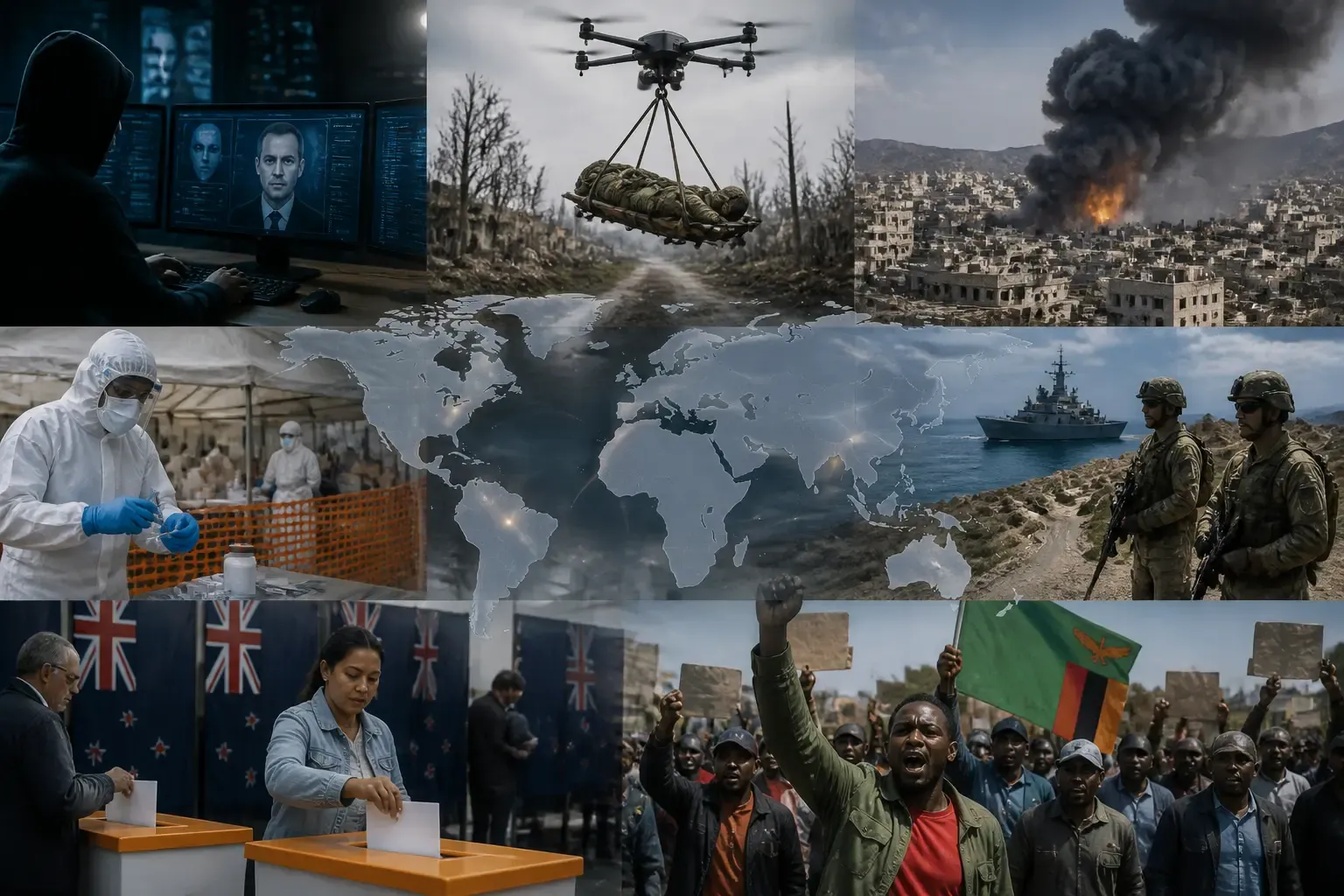
A US indictment charges individuals for AI-facilitated corporate fraud, a Ukrainian soldier is evacuated by drone, Yemen's war escalates, and New Zealand faces political uncertainty after its election.
The 60-second global view
In the US, three foreign nationals have been charged with using AI to impersonate corporate executives and attorneys in a scheme that allegedly stole over $100 million. This case highlights the growing threat of AI-driven fraud and the need for international cooperation in cybersecurity. In Ukraine, a soldier was evacuated by a drone after being stranded for eight days in a conflict zone, showcasing the innovative use of technology in military operations. Meanwhile, in Yemen, a missile strike has killed dozens, with both sides blaming each other for the attack, underscoring the ongoing humanitarian crisis in the region. In New Zealand, the general election has ended without a clear winner, with coalition negotiations expected to take weeks as results remain pending. These developments reflect the complex and interconnected nature of global challenges, from technological threats to humanitarian crises and political uncertainty.
Across the regions
Africa
In the Democratic Republic of Congo, a new study highlights the lack of an approved vaccine for the Bundibugyo strain of Ebola, which is currently causing an outbreak. The research suggests that the existing vaccine may offer some protection against multiple strains, but no vaccine has yet been approved for this variant. In Zambia, the opposition is criticizing the government's recent restructuring and layoffs across public institutions, questioning the transparency of the process. Officials have defended the changes as necessary, citing the need for institutional realignment and the use of 'national interest' provisions.
- Ebola outbreak highlights lack of vaccine for Bundibugyo strain
- Zambia's opposition criticizes government restructuring and layoffs
Asia Pacific
New Zealand's general election has concluded without a clear winner, with neither the National Party nor Labour securing a majority. Coalition negotiations are expected to take weeks as final results remain pending. The current tally suggests a 130-seat parliament, with a projected right-leaning bloc close to securing a majority. The centrist Opportunity party, which has entered parliament with seven seats, could play a pivotal role in forming a governing coalition. Final results are expected on 27 November, with hundreds of thousands of special votes yet to be counted.
Europe
A Ukrainian soldier was evacuated by a drone after being stranded for eight days in the Kharkiv region following an injury from a mine. The rescue, conducted by the Ukrainian company SkyFall using a drone named StarGate, was the first of its kind in such a mission. The drone, equipped with AI navigation, was used to counter potential GPS interference and avoid detection by Russian forces. The operation involved a complex and risky mission, with Ukrainian pilots planning the route for a week. The soldier, Artem Lytvyn, was eventually transported to safety, though he faced challenges such as untreated wounds and the presence of maggots on his leg.
Middle East
In Yemen, a missile strike in Taiz governorate killed dozens, with both sides in the war blaming each other for the attack. The internationally recognised government continues its offensive against Houthi rebels, aiming to recapture areas under Houthi control and liberate Sanaa. The offensive has relied on air support from the Saudi-led coalition and ground operations by government military coalitions. Recent advances include the recapture of positions around Dhubab and Bab al-Mandeb, though the extent of these gains remains unconfirmed. In a separate development, the US military has established a new task force to disrupt Iran's land-based supply routes, expanding its existing naval blockade of Iranian ports in the Strait of Hormuz. The task force, Task Force Iron Gate, will coordinate with other US government agencies to monitor and restrict the movement of sanctioned materials and illegal revenue streams across Iran’s land borders and the Caspian Sea.
- Dozens killed in Yemen missile strike as war intensifies
- US military establishes task force to disrupt Iran's land-based supply routes
US
Three foreign nationals have been arrested and charged with using AI to impersonate corporate executives and attorneys in a scheme that allegedly stole over $100 million. According to a newly unsealed indictment by the US Department of Justice, Jacob Soall, Sharon Hazan, and Guy Sheetrit used AI to alter and impersonate the voices and images of executives and attorneys at various companies. They targeted employees with fake requests for financial transactions, directing them to contact lawyers at a large international law firm. The men then impersonated these lawyers to convince employees to wire large sums of money. Soall and Hazan were arrested in Spain over the summer, while Sheetrit was arrested in the United Kingdom in September. The alleged fraud occurred between 2024 and 2026.
What connects them
The use of AI in the US fraud case highlights the growing threat of AI-driven cybercrime, which could have implications for global cybersecurity efforts. In Ukraine, the successful drone rescue operation demonstrates the potential of emerging technologies in military and humanitarian contexts, which may influence future strategies in conflict zones. In Yemen, the intensifying conflict and the humanitarian crisis underscore the need for international intervention and support for displaced populations. In New Zealand, the political uncertainty following the election could have broader implications for regional stability and governance. The US military's new task force targeting Iran's supply routes may further escalate tensions in the Middle East, potentially affecting global energy markets and regional security dynamics.
This section reflects Dumpling editorial interpretation and is provided for context only.
What to watch
The US indictment of individuals using AI to impersonate corporate executives highlights the need for international cooperation in addressing AI-driven fraud and cybersecurity threats.
The successful drone rescue of a Ukrainian soldier in Kharkiv demonstrates the potential of emerging technologies in military and humanitarian contexts, which may influence future strategies in conflict zones.
The ongoing conflict in Yemen and the humanitarian crisis underscore the need for international intervention and support for displaced populations, as the situation continues to worsen.
This section reflects Dumpling editorial interpretation and is provided for context only.