
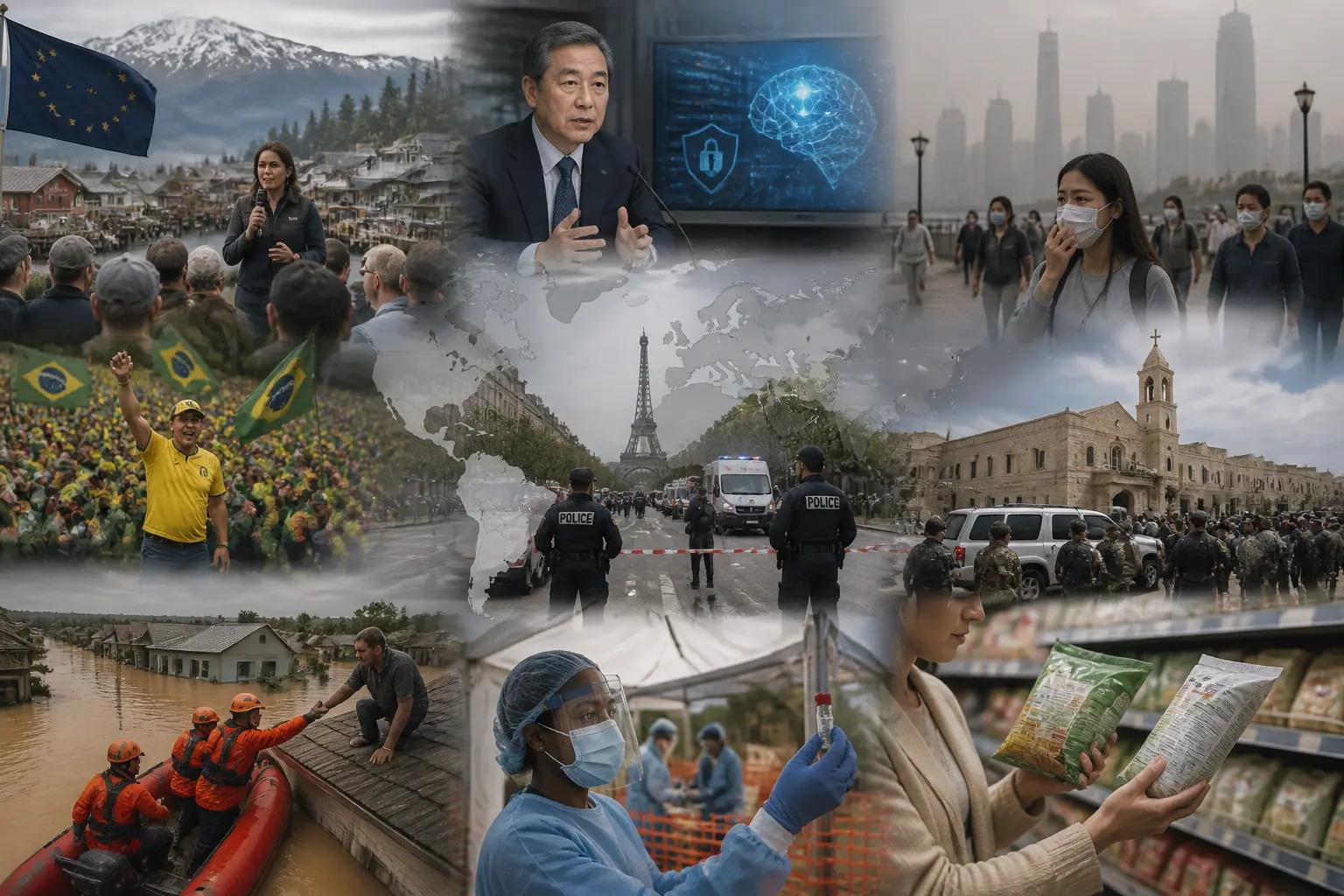
From political races in Alaska to cyber threats in Japan, global events highlight economic, environmental, and security concerns. Regional developments in Brazil, Jordan, and Kenya underscore ongoing challenges.
The 60-second global view
Global headlines today reflect a mix of political, environmental, and security challenges. In the United States, the Alaska Senate race is intensifying as economic struggles and political influence shape the contest. Meanwhile, in the Asia Pacific, the Bank of Japan warns of AI and cyber risks, while Singapore grapples with worsening air quality. In the Americas, Brazil's presidential race has significant implications for the Amazon, and in Jordan, a deadly attack at a church funeral has shocked the region. In Europe, a deadly shooting near Paris has been labeled a 'racist terrorist attack,' and supermarket shrinkflation is raising consumer concerns. In Africa, Kenya reports a second Ebola death, highlighting the ongoing public health challenge.
These developments illustrate the complex interplay of local and global issues, from political contests and environmental threats to public safety and economic practices. Each region faces its own set of challenges, yet the interconnected nature of the modern world means that events in one area can have ripple effects elsewhere. As the day unfolds, the focus remains on how these events will shape the trajectory of global affairs.
Across the regions
Africa
Kenya's Health Ministry confirmed a second Ebola death, a 65-year-old woman who was a close relative of the first patient. The woman died while in quarantine in Nairobi. The ministry stated that medical personnel did everything possible to save her life and that a safe and dignified burial would be arranged in consultation with her family. Kenya's first Ebola case was announced on October 6. The virus was found in a 40-year-old Kenyan man living in Congo, who travelled to Kenya via Uganda, arriving on October 3. Of some 135 identified contacts, 118 were placed in quarantine, with eight testing positive. Seven people continue to receive treatment for the illness in Kenya, all within one cluster with no evidence of community spread.
Americas
In Brazil, far-right presidential candidate Flávio Bolsonaro received strong support in Amazon towns, particularly in Mucajaí, where nearly 79% of 11,734 votes went to him in the first round of Brazil’s presidential election. His campaign promises to legalise mining on Indigenous lands and create jobs have drawn backing from residents who say economic hardship has worsened since Lula’s environmental crackdowns. Indigenous leaders and conservationists warn that a Bolsonaro victory could lead to renewed illegal mining in the Yanomami Indigenous territory, which suffered severe damage during his father’s presidency. Signs of renewed illegal activity have already been reported, with prospectors contacting Indigenous villagers to prepare for their return. The outcome of Brazil’s presidential runoff election could significantly impact the Amazon rainforest and the communities living there, with Roraima being a key region to watch. The runoff election in Brazil has drawn particular attention in Roraima, the country’s northernmost state, where residents are closely following the contest between candidates. The region heavily supported Flávio Bolsonaro in the first round, and some locals express hope that he may revive mining activities previously encouraged by his father, Jair Bolsonaro, whose administration oversaw the loss of 11 million acres of rainforest. Indigenous activists in the area are also preparing to resist any policies that could threaten the environment, even if the Bolsonaro family regains power.
- Brazil's Amazon towns see strong support for far-right presidential candidate
- Brazilian presidential runoff holds high stakes for Amazon and its communities
Asia Pacific
The Bank of Japan has highlighted growing risks from AI and cyberattacks, warning of potential market shocks and cybersecurity threats that could affect the country's banking system. The Bank of Japan noted in its semi-annual report that while no major financial imbalances were observed, rising property and stock prices require careful monitoring due to low interest rates. Japanese banks have increased lending to foreign non-bank financial institutions, making the financial system more vulnerable to global market fluctuations. The report warned that if AI-related investment expectations decline, shocks could be amplified through portfolio adjustments in the foreign non-bank financial institution sector, potentially spilling over to Japan. Cyberattacks using AI have already caused global website shutdowns, prompting the BOJ to urge financial institutions to prepare for threats like the misuse of generative AI. Air quality in Singapore deteriorated overnight, with the 24-hour Pollutant Standards Index (PSI) reaching the unhealthy range across all five regions early on Saturday. The 24-hour Pollutant Standards Index (PSI) reached the unhealthy range across all five regions of Singapore early on Saturday, with readings ranging from 112 to 139 at 6am. Hourly PM2.5 concentrations were also elevated, with levels from 72 in the east to 115 in the west. The highest PSI reading was recorded in the western region, indicating the most severe air quality conditions in that area. The National Environment Agency (NEA) reported that smoke haze from Sumatra had been observed drifting towards Singapore, with similar conditions detected over Kalimantan. Dry conditions in Singapore contributed to the worsening air quality. Showers are forecast for Saturday, but smoke haze may continue to be transported from Sumatra under prevailing south-southeasterly or south-southwesterly winds. Conditions could improve from Sunday, when winds are expected to shift to blow from the southwest or west, potentially reducing the amount of smoke haze transported towards Singapore.
- Bank of Japan warns of AI and cyber risks to banking system
- Singapore air quality reaches unhealthy levels as haze worsens
Europe
A shooting near Paris killed one person and injured five others, with the suspect apprehended. French President Emmanuel Macron called the attack a 'racist terrorist attack' and described it as a turning point for the nation. The attack unfolded over a 15-minute period, with the suspect firing from his car in Trappes and nearby La Verrière, targeting individuals of migrant origin. The suspect, identified as Kevin T, had four prior convictions that were automatically expunged. He was not considered a serious threat to French security by intelligence services. The incident involved multiple locations, including a petrol station, a medical centre, and a playground in Trappes, before the suspect drove to La Verrière. Witnesses reported that the suspect drove through several neighbourhoods in a grey Renault Clio, firing randomly with the intent of causing as many casualties as possible. Three of the injured, including a 12-year-old girl, remain in serious condition. The National Anti-Terrorist Prosecutor's Office described the incident as 'murder in connection with a terrorist enterprise.' A family member of the suspect was also taken into custody. European consumers are noticing smaller product sizes in supermarkets without corresponding price reductions, a trend known as shrinkflation. Supermarket products such as chocolate bars and toothpaste are being reduced in size while maintaining the same price, according to recent observations. This practice, referred to as shrinkflation, has raised concerns among shoppers who feel they are paying the same for less. The phenomenon has been noted in various product categories, with manufacturers adjusting packaging sizes without altering the listed price points. The trend has been reported across multiple retail chains, with no significant changes in pricing despite reductions in product volume. Consumer advocacy groups have begun to monitor the situation more closely, seeking further details on how this affects overall spending habits. Shrinkflation has become a growing topic of discussion as consumers increasingly notice discrepancies between product quantity and value, prompting calls for greater transparency in pricing and packaging practices.
- Deadly shooting near Paris labeled 'racist terrorist attack' by Macron
- Supermarket shrinkflation leads to smaller products at the same price
Middle East
Gunmen opened fire during a church funeral in Jordan, killing seven people and wounding 40 others. The attack occurred at a Greek Orthodox church in Karak, south of Amman. Footage broadcast on Jordanian state television showed two gunmen approaching a Greek Orthodox church in Karak and firing shots. A third man, seen carrying a semiautomatic rifle, then joined the attack before all three ran toward the church. Witness video captured broken glass and bloodstains inside the church. The attack occurred during a funeral and resulted in seven deaths and 40 injuries, according to authorities. Dorgham Halasa, a mourner present at the church, said intense gunfire erupted 15 minutes after the funeral had started, prompting people to flee. He did not see the attackers, though others reported seeing four individuals involved. Authorities described the attack as being carried out by unknown assailants, with no immediate details on the capture or death of any gunmen. Jordan has declared three days of national mourning, and the health minister reported that two of the wounded are in critical condition. Regional leaders have condemned the attack as a terrorist act.
US
Mary Peltola's campaign highlights rural Alaska's economic struggles as she seeks to unseat Republican Dan Sullivan in the November midterms. Alaska's Senate race has become a focal point as Mary Peltola, a pro-oil Democrat, campaigns in remote areas facing extreme cost-of-living challenges. Prices for basic goods and utilities have surged, with power bills reaching $1,500 monthly in some communities reliant on generators. These conditions are central to her strategy to win the seat, currently held by Republican Dan Sullivan. Trump has supported Sullivan, emphasizing concerns over Peltola's alleged ties to Washington, D.C., and her past treatment of staff. Meanwhile, Peltola emphasizes her alignment with Alaska's interests, including its oil and gas industries. The race is highly competitive, with outside groups funding both campaigns and a Republican primary challenger potentially splitting Sullivan's vote. Severe flooding in the Four Corners region led to water rescues, impassable roads, and evacuation orders in Colorado and New Mexico, with some residents advised to shelter in place. Flooding in the Four Corners region, which includes Colorado, New Mexico, Arizona, and Utah, prompted water rescues, including from rooftops, and impassable roads. Residents in low-lying areas of Colorado and New Mexico were ordered to evacuate, while others were told to shelter in place until water levels receded. Earlier in the week, tornadoes in Arizona caused damage to homes and infrastructure, with at least one person injured. Rescue efforts continued on Friday, with New Mexico guard boats, helicopters, and amphibious vehicles assisting in evacuations. Officials reported that some homes had 3 to 4 feet of water, and rising river levels exceeded forecast crests. In Farmington, about 600 households were told to evacuate, and areas along the San Juan River were closed off. A flood warning in Rio Chama noted that the current extent of flooding along the San Juan River had not been observed since before the completion of Navajo Dam.
- Alaska Senate race hinges on cost-of-living crisis and Trump's influence
- Severe flooding in US west triggers rooftop rescues and evacuation orders
What connects them
The interconnected nature of today's global events is evident in several ways. In the Americas, the political developments in Brazil and the environmental challenges in the US highlight the complex relationship between governance and natural disasters. The potential impact of a Bolsonaro victory on the Amazon rainforest could have far-reaching consequences for global climate efforts, while the severe flooding in the US west underscores the immediate and local effects of extreme weather. In the Asia Pacific, the Bank of Japan's warnings about AI and cyber risks intersect with Singapore's environmental challenges, as both regions grapple with the dual threats of technological disruption and climate change. In Europe, the deadly shooting near Paris and the issue of supermarket shrinkflation reflect the diverse challenges faced by the region, from public safety to economic practices. In the Middle East, the attack in Jordan has drawn regional condemnation and highlights the ongoing security concerns in the area. In Africa, Kenya's second Ebola death underscores the persistent public health challenges that can have global implications. These events, while distinct in their contexts, collectively illustrate the multifaceted nature of global challenges and the need for coordinated responses.
This section reflects Dumpling editorial interpretation and is provided for context only.
What to watch
Mary Peltola's campaign highlights rural Alaska's economic struggles as she seeks to unseat Republican Dan Sullivan in the November midterms.
The potential for renewed illegal mining in the Amazon rainforest following a Bolsonaro victory raises concerns for environmental conservation and Indigenous communities, with local and global stakeholders closely monitoring the situation.
The ongoing air quality crisis in Singapore highlights the need for regional cooperation to address transboundary environmental issues, as smoke haze from Sumatra continues to affect the region.
This section reflects Dumpling editorial interpretation and is provided for context only.