
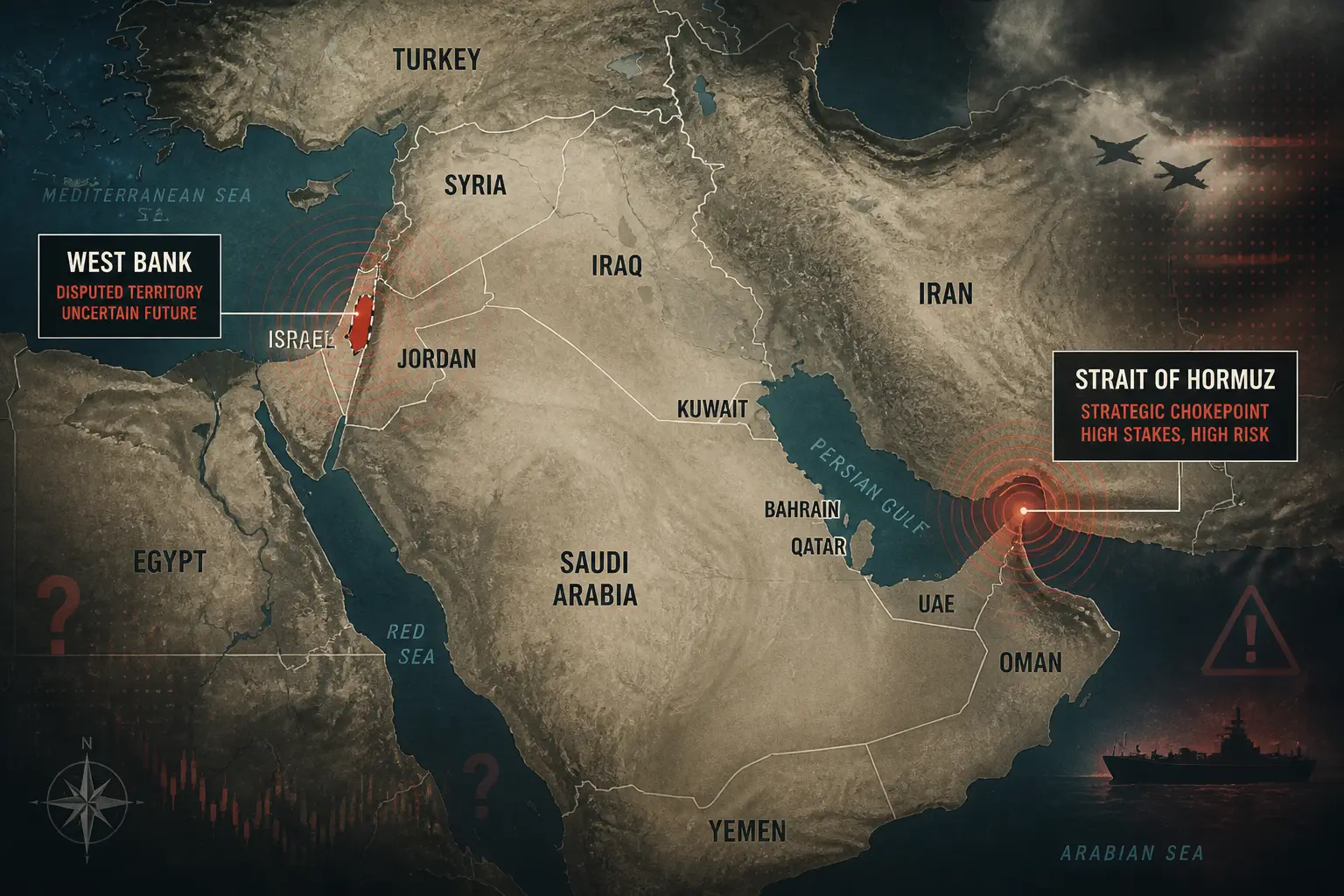
Israeli plans to shift West Bank law enforcement to police face strong Palestinian opposition, while Trump's remarks on the Strait of Hormuz raise new geopolitical concerns.
Israeli defense minister Israel Katz has announced plans to transfer law enforcement responsibilities in the occupied West Bank from the military to the police, a move that has been condemned by Palestine’s vice-president as a violation of international law and a step toward full annexation. Meanwhile, former U.S. president Donald Trump has threatened to declare the Strait of Hormuz as U.S. territory, a statement that has sparked uncertainty about the direction of U.S. policy toward Iran.
These developments highlight the deepening tensions in the region, with both Israel and the United States signaling potential shifts in their strategic approaches. The implications of these moves remain unclear, but they underscore the fragile nature of the current geopolitical landscape in the Middle East.
1. Israeli military plans to transfer law enforcement in occupied West Bank to police
Israeli defense minister Israel Katz has announced plans to transfer law enforcement responsibilities in the occupied West Bank from the military to the police. This move has been met with strong opposition from Palestinian officials, who have described it as a flagrant violation of international law and a step toward full Israeli annexation of the territory. The plan, which is currently in the drafting stage, would see the military hand over responsibility for policing Israeli settlers and managing security operations to the Israeli police force.
Palestine’s vice-president has condemned the proposal, calling it a dangerous escalation that could further destabilize the region. The move has also drawn criticism from international human rights organizations, who warn that it could lead to increased violence and further erode the prospects for a peaceful resolution to the Israeli-Palestinian conflict.
Why it matters
Israeli military plans to transfer law enforcement in occupied West Bank to police, but the available facts do not establish the next outcome.
What to watch
Watch for official follow-up that clarifies the next steps, timing and measurable effects of this development.
Source: The Guardian Middle East
2. Trump threatens to declare strait of Hormuz 'territory of the United States'
Former U.S. president Donald Trump has threatened to declare the Strait of Hormuz as “a territory of the United States,” a statement that has raised questions about the potential direction of U.S. policy toward Iran. The remark, made during a speech in New York, has been interpreted as a signal of a more assertive stance on the part of the Trump administration in the region. The Strait of Hormuz is a critical chokepoint for global trade, through which about a fifth of the world’s seaborne oil passes.
While the seriousness of the remark remains unclear, it has sparked concern among analysts and regional actors. The statement could be seen as a warning to Iran or a sign of a broader strategy to increase U.S. influence in the Gulf. However, it is not yet clear whether this would translate into any concrete policy changes or actions.
Why it matters
Trump threatens to declare strait of Hormuz 'territory of the United States', but the available facts do not establish the next outcome.
What to watch
Watch for official follow-up that clarifies the next steps, timing and measurable effects of this development.
Source: The Guardian Middle East
The Dumpling take
Israeli military plans to transfer law enforcement in the occupied West Bank to police, a move Palestine’s vice-president calls a flagrant violation of international law. Meanwhile, Trump has threatened to declare the Strait of Hormuz as U.S. territory, though the intent behind the remark remains unclear.
This section is Dumpling editorial analysis, based on the sourced reporting above.