
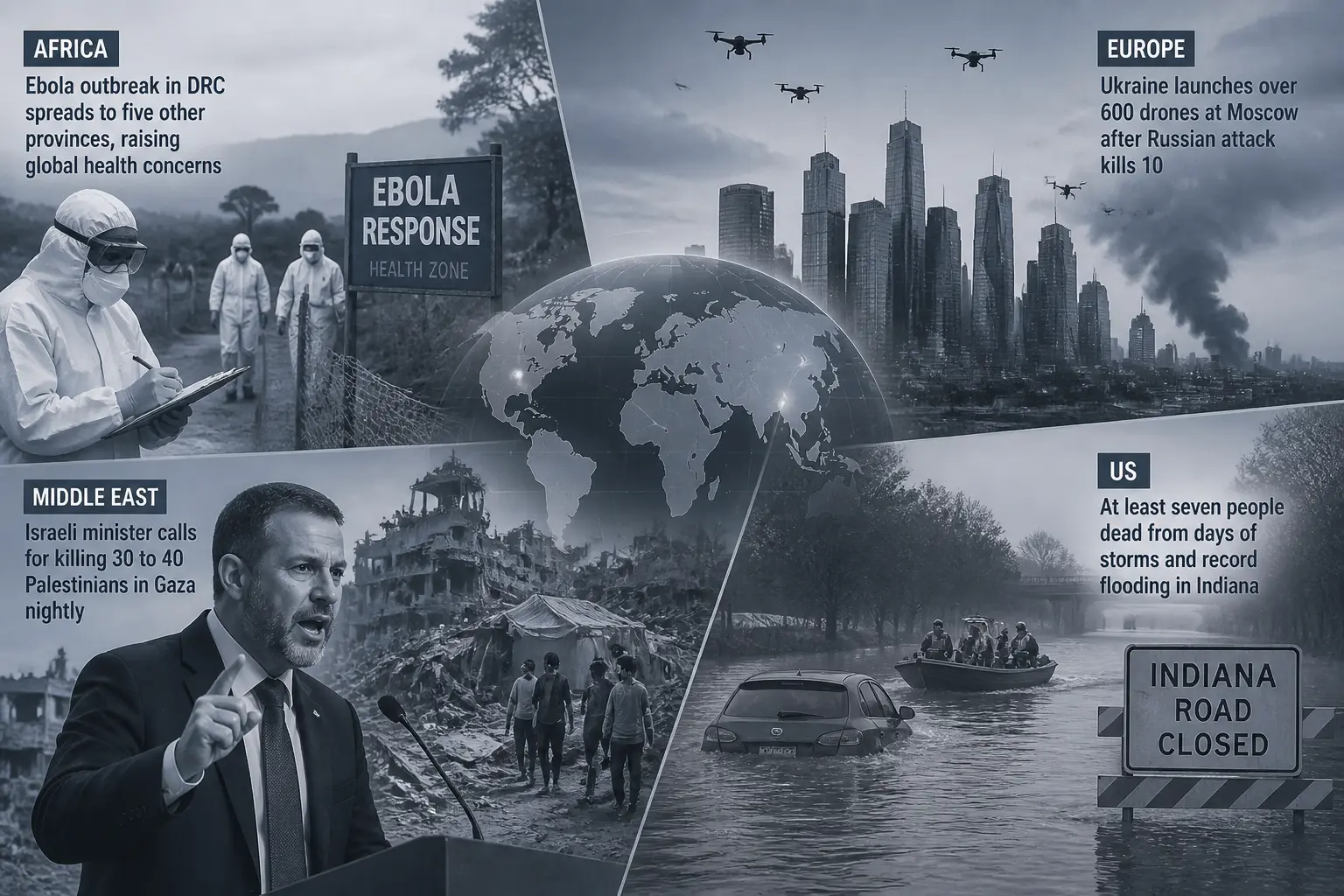
Severe weather, political tensions, and health emergencies are escalating across the globe, with impacts felt from the United States to the Middle East and Africa.
The 60-second global view
Natural disasters, geopolitical conflicts, and public health crises are converging to create a complex and challenging global landscape. In the United States, severe storms and flooding have caused multiple fatalities, while in the Middle East, inflammatory rhetoric from Israeli officials has heightened tensions. In Africa, an Ebola outbreak is expanding rapidly, raising concerns about containment and global health security. Meanwhile, in Europe, Ukraine's response to a Russian attack has escalated the conflict further. These developments underscore the interconnected nature of global challenges and the need for coordinated international responses.
Across the regions
Africa
An Ebola outbreak in the Democratic Republic of the Congo has spread to five additional provinces, marking a significant escalation in the crisis. With 4,945 confirmed cases and 2,325 deaths, the situation is being complicated by conflict, misinformation, and a lack of trust in health workers. The Bundibugyo virus strain is being tested with new vaccines, but the response is hindered by ongoing challenges in the region.
Europe
Ukraine has launched over 600 drones at Moscow and surrounding areas in response to a Russian attack that killed 10 people. President Zelenskyy confirmed the retaliatory strikes and called for international support. French prosecutors are investigating allegations that former prime ministers may have been targeted by Russian destabilisation operations, adding another layer of complexity to the ongoing conflict.
Middle East
An Israeli far-right minister has called for the killing of 30 to 40 Palestinians in Gaza each night, according to a recent podcast. National Security Minister Itamar Ben-Gvir made the remarks during a conversation with a former captive held in Gaza. His comments have raised concerns about the escalation of violence and the potential for further destabilisation in the region.
US
At least seven people have died in Indiana due to severe storms and flooding that began on 11 August. Floodwaters peaked in Indianapolis, with emergency shelters remaining open and recovery efforts underway. The situation highlights the ongoing threat of extreme weather events and the need for continued preparedness and response measures.
What connects them
The global landscape is marked by a convergence of natural disasters, political tensions, and health emergencies. In the United States, the impact of severe storms and flooding underscores the vulnerability of regions to extreme weather events. In the Middle East, inflammatory rhetoric from Israeli officials highlights the deepening tensions in the region, which could have broader implications for international stability. In Africa, the rapid spread of the Ebola outbreak raises concerns about global health security and the challenges of responding to such crises in conflict-affected areas. In Europe, the escalation of the Ukraine-Russia conflict continues to draw international attention and calls for support. These developments, while distinct, collectively illustrate the interconnected nature of global challenges and the need for coordinated international responses.
This section reflects Dumpling editorial interpretation and is provided for context only.
What to watch
- Ebola outbreak in DRC may expand further due to ongoing conflict and lack of trust in health workers.
- Ukraine's drone strikes on Moscow may lead to further escalation of the Russia-Ukraine conflict.
- Israeli minister's remarks may increase tensions in the Middle East and impact regional stability.
This section reflects Dumpling editorial interpretation and is provided for context only.